 inquiry@kolaxoprint.pk


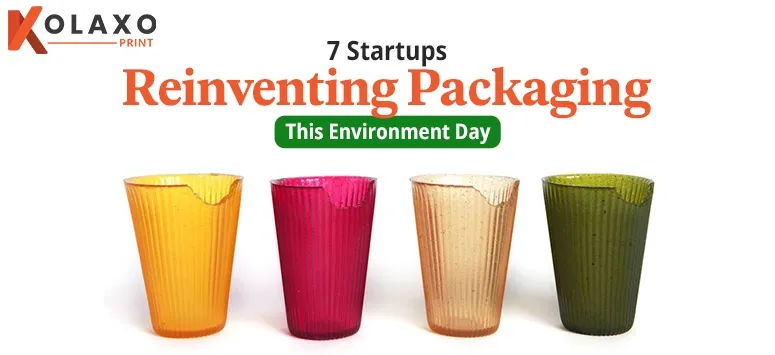
7 Startups Reinventing Packaging This Environment Day
It’s not something for the future anymore. As the EU Packaging and Packaging Waste Directive makes recyclability mandatory, retail giants start implementing their suppliers’ ESG metrics, and consumers switch brands based on packaging alone, the need for procurement and product departments has never been more urgent.
World Environment Day may serve as a good nudge, but the true debate lies elsewhere. The question is no longer whether there’s enough knowledge.
It’s about the viability of certain innovations, their potential integration into your current supply chain, and what you stand to gain by doing so.
7 Startups Reinventing Packaging
Here are seven companies reinventing packaging this Environment Day.
1. Notpla
Best fit for: QSR chains, food delivery platforms, beverage brands, and event caterers.
Notpla’s technology is not merely in its proof-of-concept phase. They’ve implemented their seaweed-based packaging in their own products, such as takeaway containers, sachet packets, and coatings for paper products, with hundreds of thousands of units produced via a Deliveroo collaboration.
Notpla's packaging degrades within weeks in a natural environment without the need for industrial composting facilities.
For buyers, here's the critical point: Notpla’s coatings mean that you won’t need to add a plastic layer to your existing takeaway packaging, making it non-recyclable by current standards. Making just that one tweak may completely alter your product life cycle.
2. Loliware
Best fit for: Hospitality groups, airline catering, stadium, and venue operators.
The straws and serviceware from Loliware have met one of the most challenging metrics in the foodservice industry: performance.
The straws stay intact for extended periods in cold and hot drinks – an issue that has been a barrier to the adoption of paper straws by many hospitality purchasing departments.
Apart from performance, Loliware presents itself as the best choice for brands with a regulatory compliance-first agenda.
3. Skipping Rocks Lab (Ooho)
Best fit for: Sports nutrition brands, event sponsors, pharma sample packaging, and beverage brands.
Ooho sachets by Skipping Rocks Lab use flexible membranes made from seaweed that degrade within six weeks and address a unique challenge of single-serve liquid packing during activations, where plastic waste collection becomes both expensive and damaging to corporate reputation.
For marketing teams planning experiential campaigns, the price point matches that of standard sachets while providing media exposure.
4. Ecovative Design
Best fit for: Electronics manufacturers, furniture and homewares brands.
The packaging solution by Ecovative using mycelium, which grows from agricultural waste in around a week's time, replaces expanded polystyrene (EPS) foam used in packaging products. It has been tested by IKEA and Dell, who have proven its efficacy in protecting fragile goods.
There is more than meets the eye in terms of economics. EPS foam faces many disposal bans imposed by municipalities, which makes it a logistical pain in e-commerce deliveries. Mycelium packaging can be home composted, thereby avoiding the hassle entirely.
5. Paptic
Best fit for: Fashion retailers, FMCG brands, and grocery chains.
The flexible material developed by Paptic, based on wood fibers, aims to provide the same properties as a plastic film, such as stretch and durability, while ensuring that it can be recycled via the normal paper process.
For companies in the retail industry that need to phase out their plastic carrier bags and flexible plastic packaging, Paptic presents itself as an alternative that does not require any behavioral change from the consumer.
6. Tipa
Best fit for: Fresh food producers, cheese and deli brands, and accessories brands.
Flexible plastic films represent one of the most stubborn problems in sustainable packaging: high utility, near-zero recyclability in practice. Tipa has built a commercially viable compostable alternative that maintains the shelf-life, barrier, and printability requirements that food brands cannot compromise on.
Their certifications cover both industrial and home composting, which matters when advising retail buyers whose customers span urban and suburban markets with different composting access.
7. Paboco
Best fit for: Beverage brands, personal care and beauty companies.
Paboco, backed by BillerudKorsnäs and Alpla, is developing paper bottles designed to replace the HDPE and PET bottles that dominate personal care and beverage shelving.
Commercial pilots are already live through Carlsberg, L'Oréal, and The Body Shop, which means the format has cleared brand safety and retail compliance reviews on a major scale.
The current iteration includes a thin inner liner; full recyclability as a single-material pack is the active development goal.
In a Nutshell!
There is a history of ambition and impracticality when it comes to materials innovations for packaging. But times are changing. Several of these companies listed below are beyond pilots, have manufacturing partners in place, and are aggressively looking for commitment from their brand and retail partners.
This is the time when you get into an exclusive relationship and gain compliance coverage and a competitive advantage before the laws have even been passed in some countries. If you are due for a review of packaging materials, then these seven should be among your RFI targets.
For sustainable packaging solutions, contact Kolaxo Print today.
-
 7 Startups Reinventing Packaging This Environment Day May 13, 2026
-
 Gift-Ready vs Gift-Worthy: Packaging Gap on Mother's Day Apr 13, 2026
-
 5 Clever Ways to Use Printed Materials to Grow Your Local Business Apr 03, 2026
-
 ISO Certified Packaging: What It Means and Why It Matters for Your Brand? Mar 23, 2026